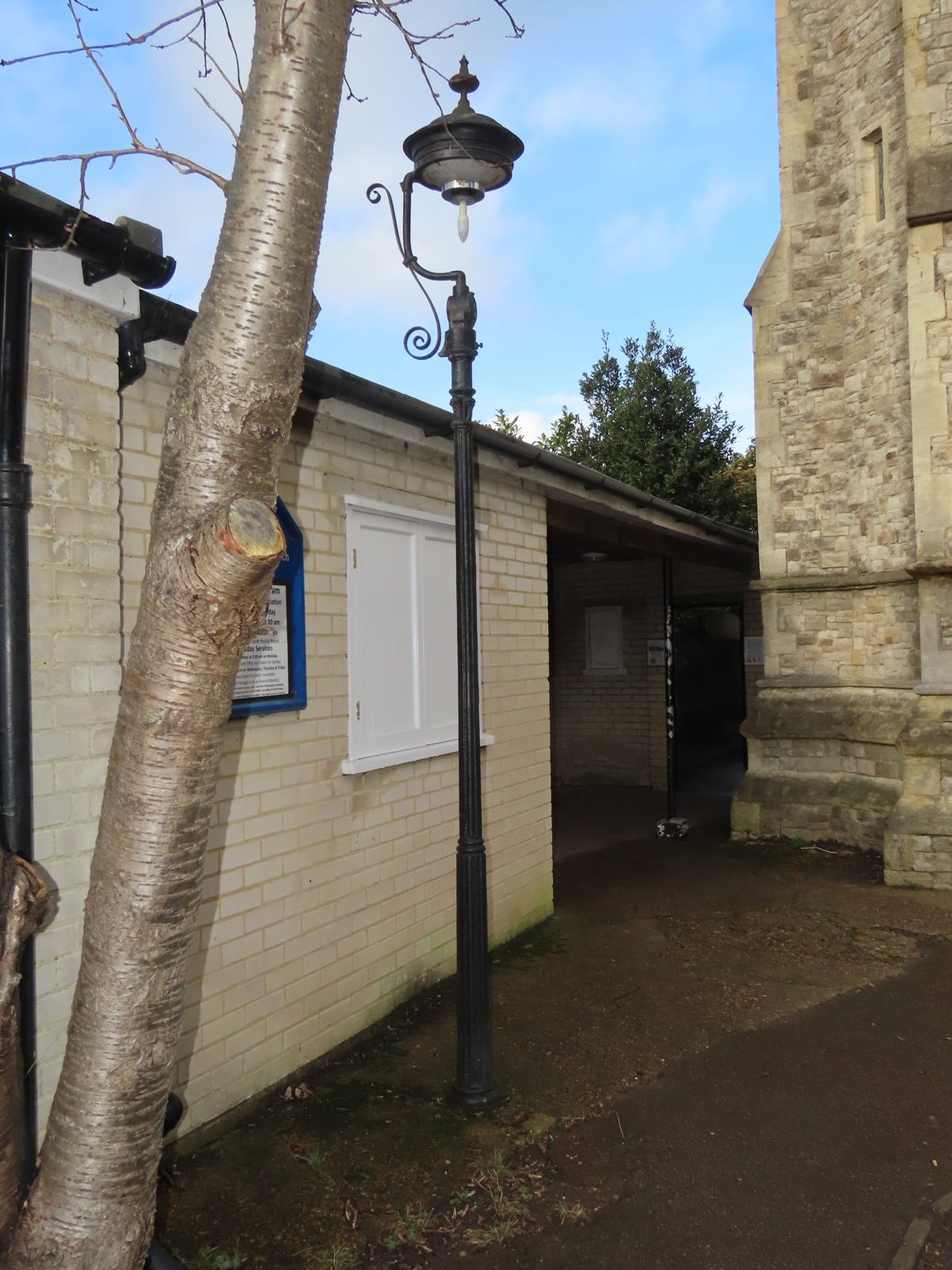
Off North Worple Way, Mortlake, London Borough of Richmond-upon-Thames Situated within the grounds of the Church of St Mary Magdalene is a 10 ft (3·048 m) fluted cast iron column with (possibly) later swan neck bracket and integrated side-entry lantern of unknown manufacturer. The lantern may have begun life as a gas lantern before being converted to electricity later, according to the Parish Priest who chatted to me after I had taken these photographs. For additional pictures of the church itself, along with the famous mausoleum housing the remains of explorer Sir Richard Burton and his wife, please click here.
The column has an unusual narrow diameter shaft.
A length of decorative scrollwork supports the bracket arm, owing to the weight of the lantern.
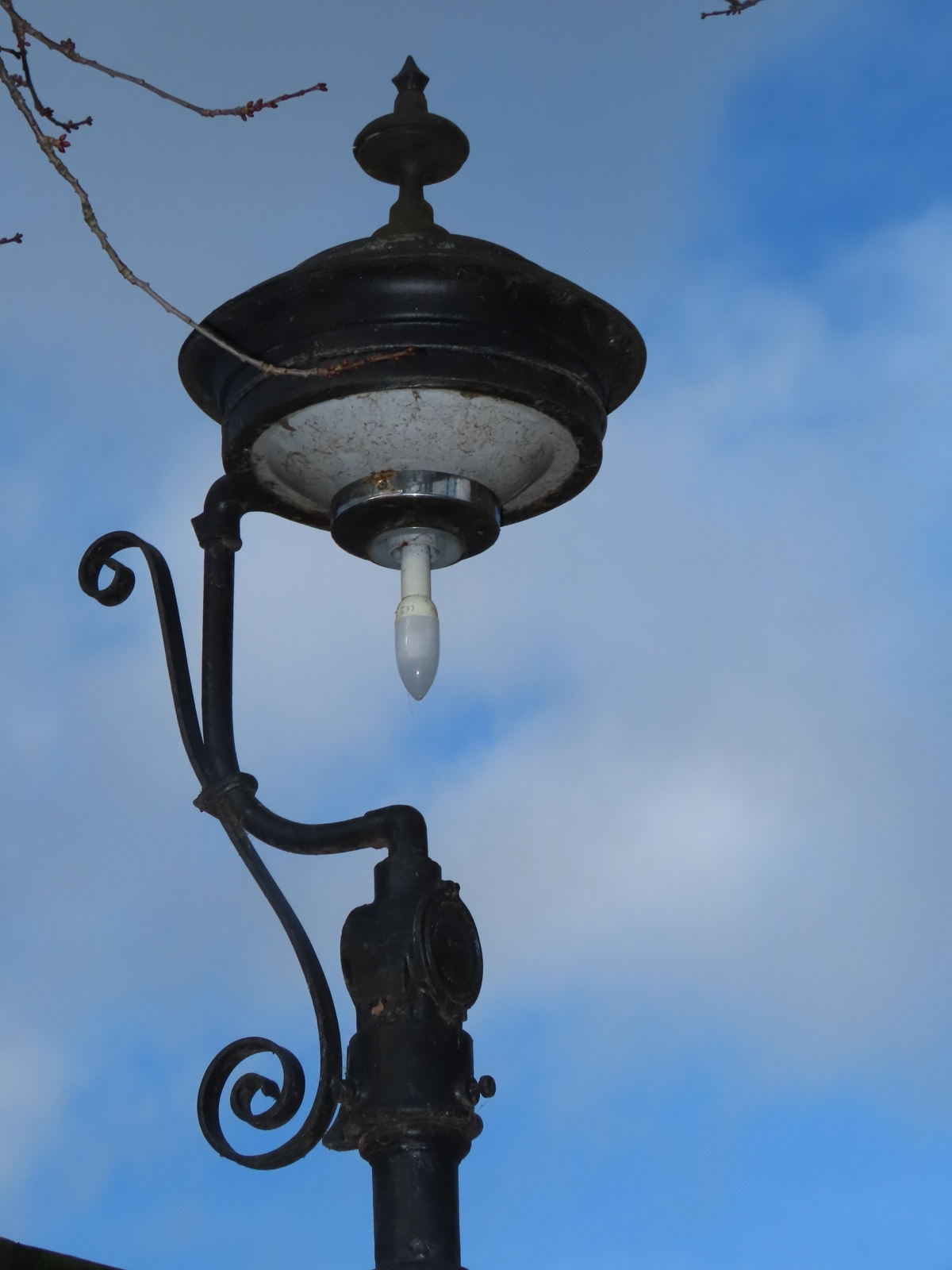
I assume that a large glass bowl would once have been fitted around the light source. The modern candle lamp protrudes from a (likely, non-original) mirrored core piece, with the original enamelled reflector then accommodating this arrangement.
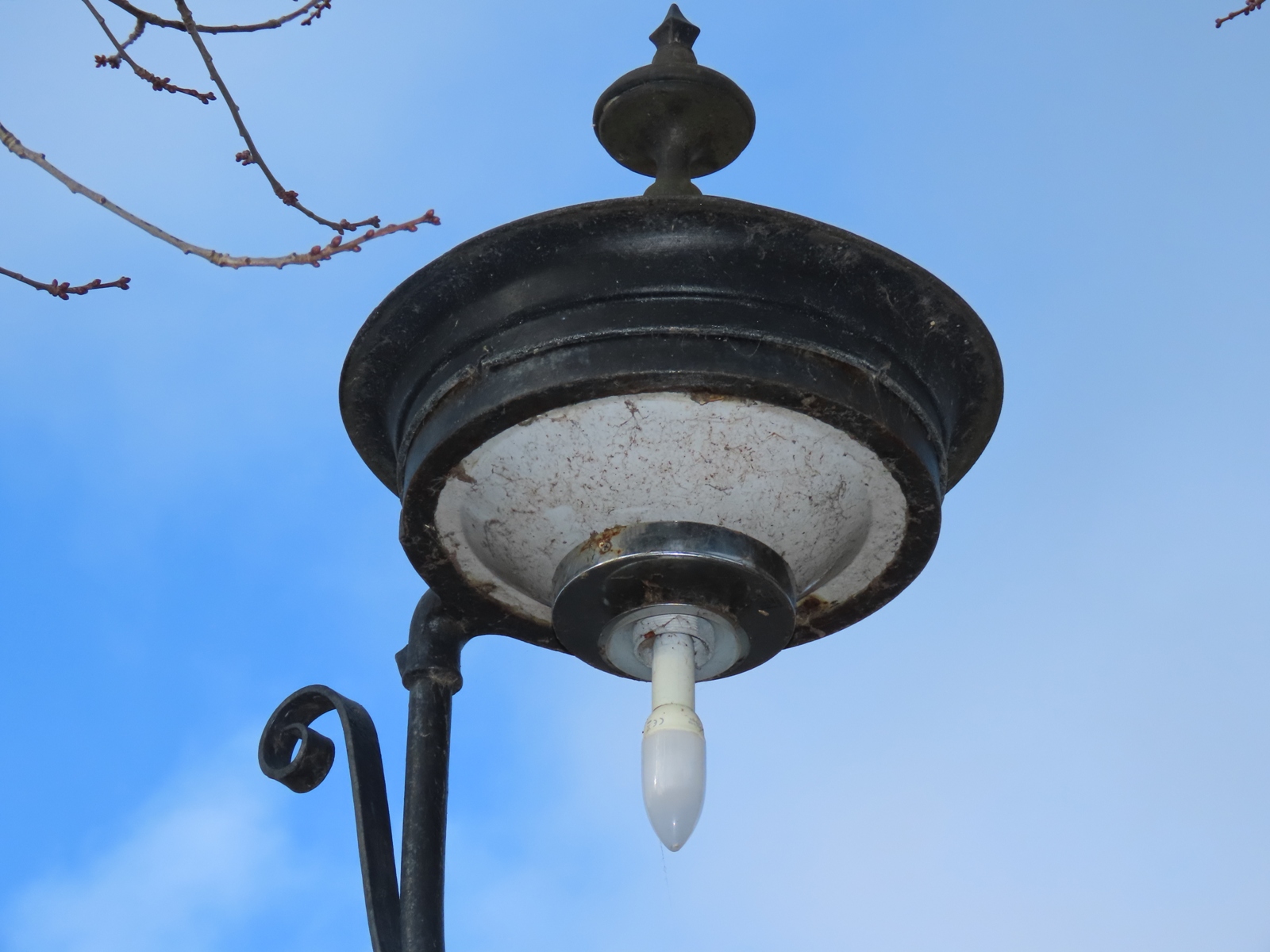
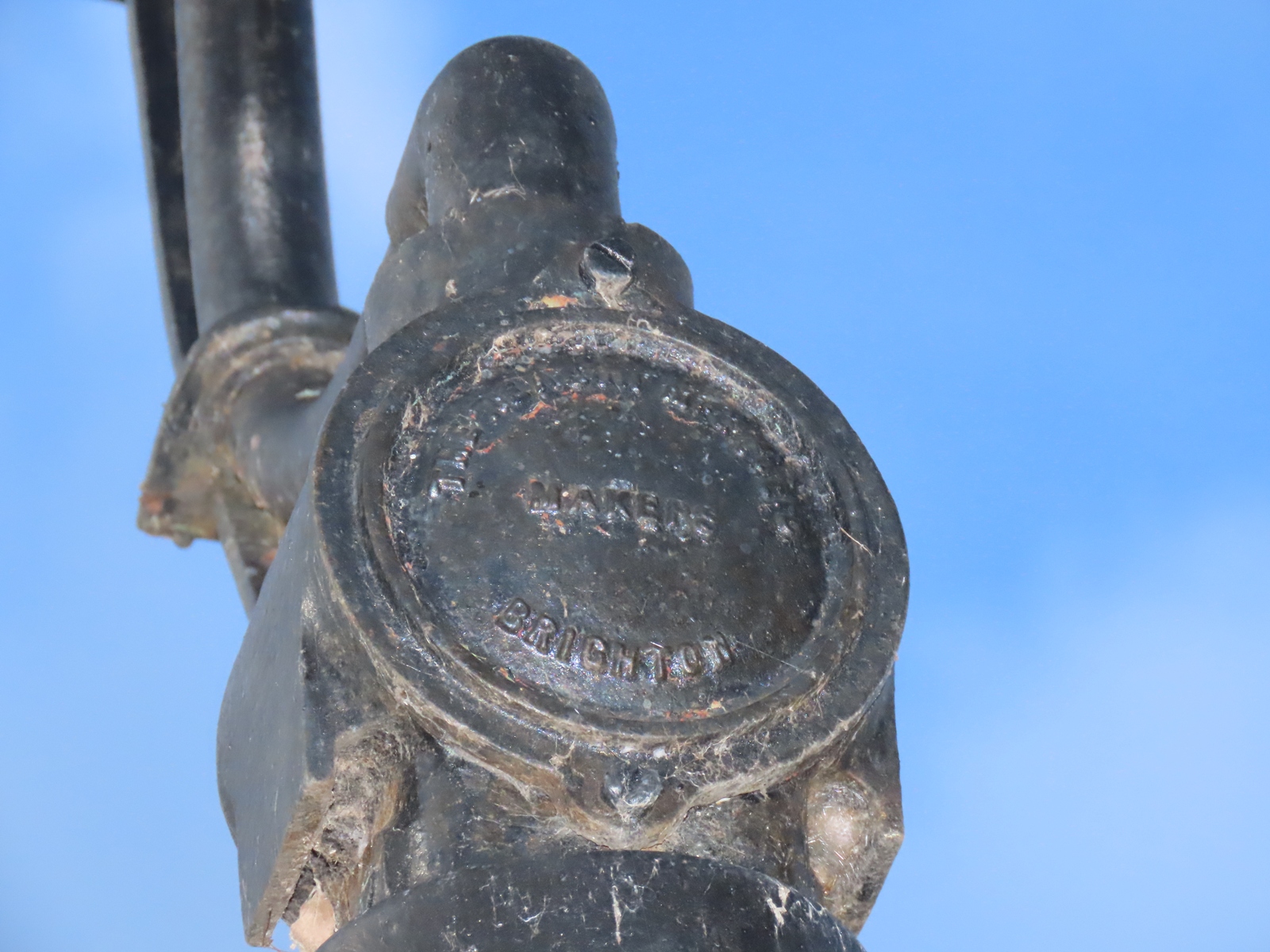
Some identification details are present on the lid of the box above the column spigot. The mention of Brighton made me wonder if this could be a Bleeco product, although I am doubtful of this.
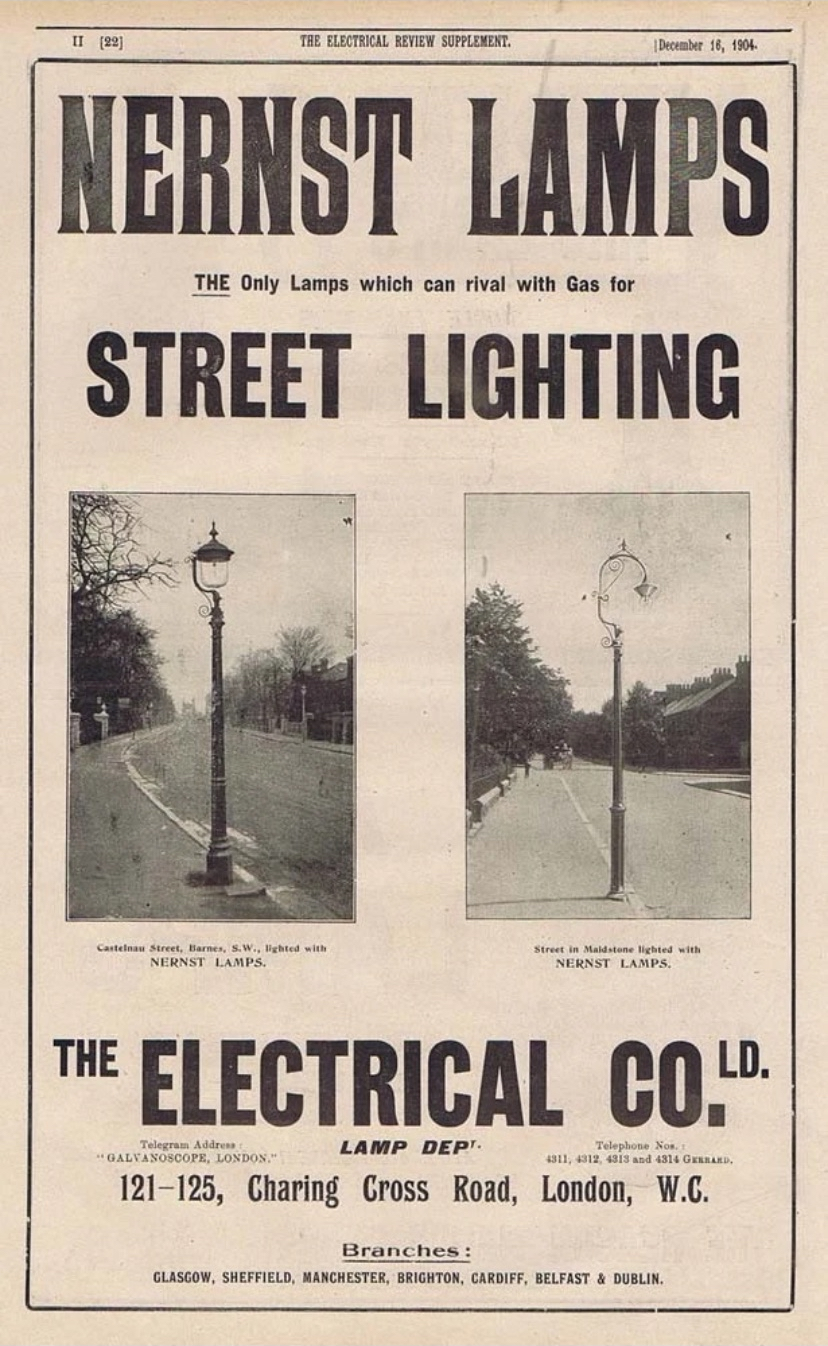
Fellow collector LeoLampposts discovered this scanned image online of a page from the Electrical Review Supplement dated the 16th December 1904, showing an identical lantern (but fitted with a bowl) on Castlenau Street in Barnes (possibly used in conjunction with the columns seen on page 12B) that ran a Nernst lamp - these were a revolutionary form of incandescent lighting developed at the end of the 19th century that utilised a ceramic "glower" rather than a metallic filament. Invented by the Nobel Prize-winning German physical chemist Walther Nernst in 1897, the lamp represented a significant bridge between early carbon-filament bulbs and modern high-efficiency lighting. Unlike the Edison-style bulbs of the era, which required a vacuum to prevent the carbon filament from burning up, the Nernst lamp’s ceramic components were already oxides and could therefore operate while exposed to the open air. Additional details regarding Nernst lamps can be read below this image.
The core of the Nernst lamp was the "glower," a small rod or tube typically composed of a mixture of rare-earth metal
oxides. The most common formulation was a combination of approximately 85% zirconium oxide (
Since the glower required pre-heating to become conductive, Nernst lamps were more complex than standard lamps. They featured an automatic starting mechanism consisting of a series of platinum heating coils (the "heater") wrapped around or positioned near the glower. When the switch was turned on, current first flowed through these heaters. Once the glower reached a sufficient temperature to conduct, a magnetic cut-out (an electromagnetic switch) would automatically disconnect the heater and allow the current to flow solely through the glower.
In the context of the early 1900s, the Nernst lamp was a high-performance luxury item. It offered several distinct advantages over the carbon-filament lamps of the day:
Luminous Efficiency: Nernst lamps produced approximately 5 to 6 lumens per Watt, roughly twice the efficiency of carbon-filament bulbs, which typically operated at 2 to 3 lumens per Watt.
Spectral Quality: The light emitted by the ceramic glower was a "pure white" that closely resembled the spectrum of natural daylight. This made it highly desirable for art galleries, high-end retail stores, and medical examinations where colour accuracy was paramount.
Durability of Materials: Since the glower did not oxidise, it did not require a vacuum-sealed glass bulb. While many Nernst lamps were enclosed in frosted glass globes, this was primarily to protect the hot glower from drafts and to diffuse the intense light, rather than to maintain a vacuum.
Walther Nernst sold the American patent rights for his invention to George Westinghouse in 1898. Westinghouse subsequently founded the Nernst Lamp Company in Pittsburgh, Pennsylvania. In Europe, the rights were held by the Allgemeine Elektrizitäts-Gesellschaft (AEG). The lamp saw its greatest commercial success between 1900 and 1905. At the 1900 Paris Exposition, the AEG pavilion was famously illuminated by 800 Nernst lamps, creating a sensation among the public.
Despite its technical superiority in light quality, the Nernst lamp faced significant hurdles. The lamps were expensive to manufacture due to the platinum used in the heaters and the complexity of the automatic cut-out mechanism. Furthermore, the "warm-up" period—which could take anywhere from 30 seconds to a minute—was a convenience drawback for residential users. The eventual downfall of the Nernst lamp was precipitated by the development of the drawn-tungsten filament by William Coolidge at General Electric in 1910. Tungsten bulbs were cheaper, turned on instantly, and eventually surpassed the Nernst lamp in efficiency.
While the Nernst lamp disappeared from general illumination by the start of World War I, the "Nernst Glower" remained a vital scientific tool for decades. Since the ceramic rod emits a high proportion of its energy in the infrared spectrum, it became the standard source for infrared (IR) spectroscopy.Scientists used these glowers to study the molecular structures of chemicals well into the late 20th century. Additionally, the lamp played a role in the development of the slit lamp by Allvar Gullstrand, a device still used today in ophthalmology to examine the human eye.
BACK TO SURVIVORS IN RICHMOND UPON THAMES
BACK TO SURVIVORS IN GREATER LONDON
CLICK HERE TO MAKE A MONETARY DONATION
© 2002 - English Street Lights Online